How To Apply?
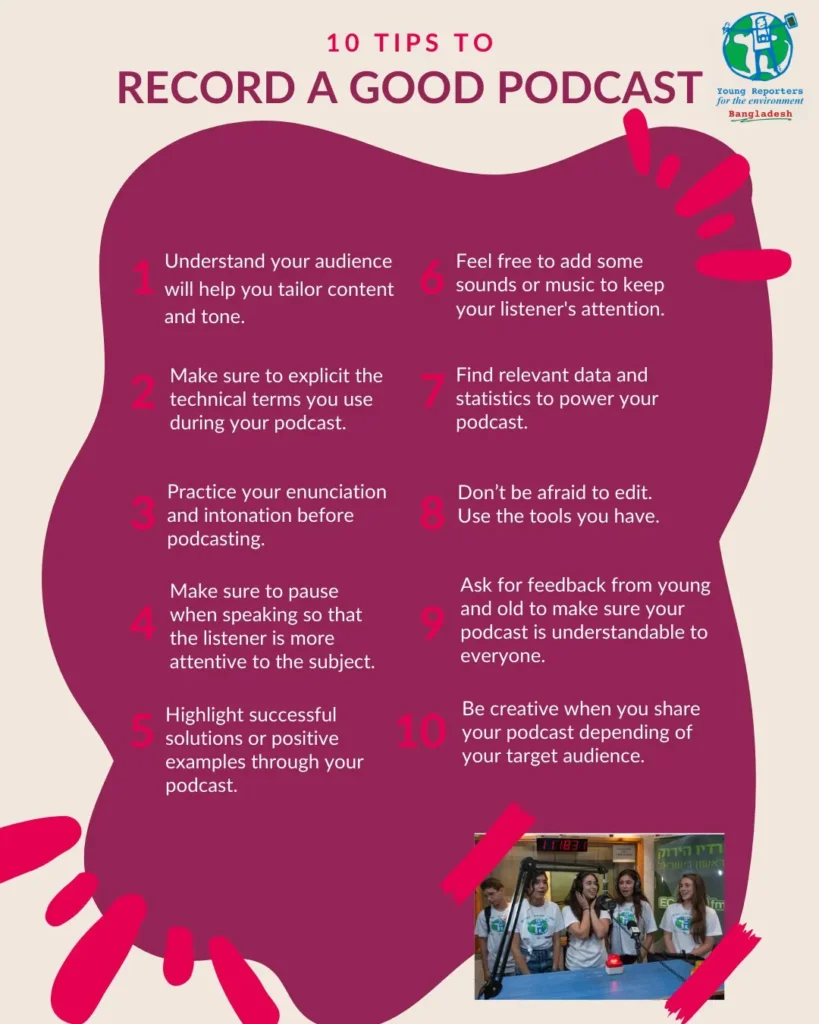
PODCAST

YRE Bangladesh Competition 2026: PodCast Journalism
Welcome to the Podcast Category of the Young Reporters for the Environment (YRE) Bangladesh Competition 2026. This category invites passionate young voices to explore the urgent theme of Food Security and Climate Change in Bangladesh through powerful audio storytelling. Participants are encouraged to use engaging conversations, interviews, narratives, and soundscapes to uncover how climate change is reshaping agriculture, food systems, and the everyday lives of communities across the country.
Your podcast should go beyond reporting facts. It should thoughtfully examine local realities, such as floods, droughts, salinity intrusion, shifting farming practices, and changing livelihoods, while connecting these experiences to broader global climate challenges. At the same time, highlight innovative ideas, community resilience, traditional knowledge, and practical solutions that strengthen sustainable food systems.
Through compelling storytelling and informed dialogue, your submission should clearly bridge the local and the global, spark critical reflection, and inspire listeners to think, act, and engage in building a more food-secure and climate-resilient future.
Let your voice amplify the stories that matter.
What to Submit
Podcasts are like mini documentaries and could take the form of audio or audio/ video. They are based on news, events, history, facts etc., and use elements of direct observation, research, interviews, and documentation. For the International Competition, only a 5-minute segment of the full podcast will be assessed by the International Jury.
The Podcast Journalism is divided into four categories:
- Narrative Podcast: Documentaries with a non-fictional or fictional environmental theme told by a narrator. This format can be immersive but requires careful planning and scripting.
- Interview Podcast: An Interview Podcast can be interviews of environmental experts, activists, or community members affected by environmental issues.
- Multi-Host Podcast: A Multi-Hosts Podcast is discussions between two or more students or experts create a dynamic flow of conversation and offer contrasting viewpoints.
- Solo Podcast: A Solo Podcast is when a single host delivers the content, offering a flexible format for time management but requiring strong storytelling skills to keep the audience engaged.
Format & Structure
- Podcast must have a title of no more than 140 characters.
- Link to the full podcast alongside a mention of the 5-minute segment timestamp selected to be submitted to the International Competition
- Must be technically of good quality. This includes sound quality.
- Recommended that the 5-minute selected segment of the podcast is succinct and direct. Highlighting the focus and solutions posed in the full podcast.
- Podcast have various formats. They can firstly have 4 types of layout: solo podcasts, multi-host podcast, interview podcast or narrative podcast. Secondly, they can either be an audio-only podcast or visual podcast.
Honest & Unbiased Reporting
- Facts, statistics, and scientific information must be supported by credible sources.
- Any quotes used must be from real and credible sources.
- Sources used in the podcast must be cited on a separate ‘References’ list.
- It is recommended that approximately 70% of the final podcast segment should be made up of students’ own original voice recording and audio. If additional external audio is used (music, sounds effects, soundbites), the original author or source must be cited in the ‘References’ list.
- The podcast is a fair and truthful representation of reality, and the sound or recording has not been edited.
Constructive & Well-Rounded Perspective
- Podcast segment should address the historical, economic, social, and/or political implications of the chosen topic through an environmental lens.
- Podcast segment should show the link between local and global events, issues, and/or phenomena.
- 5-min podcast segment should identify relevant and feasible solutions to the environmental issue(s) depicted full podcast.
Originality & Independence
- The podcast is original in subject and/or scope. The student has picked a challenging and/or creative topic or has depicted a topic in a different and/or creative way.
- The participant has engaged in fieldwork and conducted research and interviews (either in-person or over the phone) outside of their school grounds
Dissemination
A total of 5 points may be awarded for dissemination through the following channels:
- Personal Sphere = 1 Point
- School Community = 1 Point
- National Operator Organization = 1 Point
- National Media (Newspaper, TV, radio) = 2 Points
Evidence of dissemination and Reference List must be submitted alongside the podcast entry on Exposure.
***Notes
All national winning podcast segments submitted to FEE will each be awarded the Gosia Luszczek International Podcasting Award